
The C-Suite’s Guide to Evolution: Why Enterprise Architecture is Surrendering to Business Architecture
Stop letting IT dictate your strategy. Discover why Enterprise Architecture is yielding to Business Architecture and how to align your capabilities with market value.


Let us dispense with the pleasantries: if your enterprise architecture practice is currently owned, operated, and entirely dictated by your IT department, it is not an enterprise architecture at all. It is merely an IT infrastructure map masquerading as a business strategy.
For decades, executives have poured millions into Enterprise Architecture (EA), hoping it would serve as the silver bullet to align technology investments with business objectives. Yet, boardroom discussions continuously hit the same wall. Technologists speak of frameworks, servers, and integrations, while the C-suite speaks of market share, capabilities, and value streams. The translation is lost, the alignment is a facade, and the business suffers from an agility deficit.
However, the market is course-correcting. We are witnessing a definitive shift—a silent migration in the corporate landscape. The era of technology-first architecture is ending, making way for a more sophisticated, strategy-led discipline: Business Architecture.
If you want to understand why traditional Enterprise Architecture is evolving—or rather, yielding to Business-Centric Design—you must first understand why the old paradigm is failing the modern enterprise.
The Illusion of IT-Led Alignment
Historically, Enterprise Architecture was designed to be the ultimate blueprint of an organization. Frameworks like TOGAF (The Open Group Architecture Framework) provided rigorous, matrixed approaches to documenting how an organization's business, information, process, and technology layers interlocked.
The theory was sound. The execution was fundamentally flawed.
In practice, EA became an IT echo chamber. It became a discipline obsessed with the "How" and the "With What," long before anyone bothered to ask the "Why" and the "What." Technologists mapped applications, databases, and networks with excruciating detail, creating monolithic blueprints that were obsolete the moment they were printed. They expected the business to adapt to the technology, rather than forcing the technology to serve the business.
This arrogance on the part of IT led to a profound disconnect. When a CEO asks, "How do we pivot our operating model to enter the European market?" an Enterprise Architect traditionally responds with a diagram of legacy ERP integrations. It is the wrong answer to the right question.
Enter Business Architecture: The Vanguard of Strategy
This is where Business Architecture (BA) steps into the light, stripping away the technological noise to focus on what actually matters: corporate DNA.
Business Architecture is not merely a subset of IT; it is the strategic bridge between your company's high-level objectives and its operational execution. It acts as the director of the orchestra, defining exactly what the business needs to do to deliver value, leaving the how to the technologists.
To understand Business Architecture, one must master its core components:
- Business Capabilities: The foundational abilities an organization must possess to execute its business model. (e.g., "Digital Payment Processing" or "Supply Chain Routing").
- Value Streams: The end-to-end, sequential steps an organization takes to deliver tangible value to a customer or stakeholder.
- Information Maps: The critical data concepts required to support the capabilities.
- Organizational Alignment: The mapping of business units, roles, and responsibilities to the capabilities they support.
When a Business Architect sits in the boardroom, they do not discuss servers. They discuss capabilities. They translate abstract executive strategy into a concrete, operational blueprint. They ensure that before a single line of code is written, or a single software vendor is contracted, the business actually possesses the capability requirement to justify the investment.
The Strategic Architecture Shift
Evolution from IT-centricity to Strategy-led execution
Enterprise Architecture (EA)
Business Architecture (BA)
Enterprise Architecture vs. Business Architecture: The Strategic Showdown
The distinction between these two disciplines is not merely semantic; it is structural. If you look closely at the data, the market is already heavily indexing on this differentiation. Search trends surrounding "Enterprise Architecture vs. Business Architecture" have surged by over 150% recently. Why? Because the C-suite has finally realized they are paying for IT blueprints when what they actually requested was a business transformation map.
Let us clarify the boundaries:
1. Scope and Authority
Business Architecture holds the supreme authority on the "What" and the "Why." It defines the business capabilities and value streams. Enterprise Architecture is downstream; it covers the entire enterprise but is fundamentally tasked with aligning the Data, Application, and Technology layers to support the Business Architecture. Simply put, BA is the master; EA is the servant.
2. The Core Question
When an organization faces a disruption—say, the rise of Artificial Intelligence—the Enterprise Architect asks, "How can our current technology stack integrate these new AI APIs?" The Business Architect asks a far more dangerous and valuable question: "Does our business model even require this capability? And if it does, how does it alter our value delivery stream to the client?"
3. Tangible Deliverables
Enterprise Architects hand you IT strategy roadmaps, application portfolios, and cloud transition blueprints. These are necessary, but they are not strategy. Business Architects hand you Capability Maps, Value Stream definitions, and Organizational Models. These are the tools that actually allow a CEO to pull the levers of the company and see an immediate, predictable result.
The Data Doesn't Lie: Analyzing the Search Trends
If you believe this is just another consulting buzzword, I invite you to look at the macroeconomic search data over the last five years.
The global search interest for standard "Enterprise Architecture" has plateaued. The market is saturated with frameworks that have over-promised and under-delivered. Conversely, queries related to "Business Architecture," "Business Enterprise Architecture," and specifically the comparison between the two, are aggressively rising.
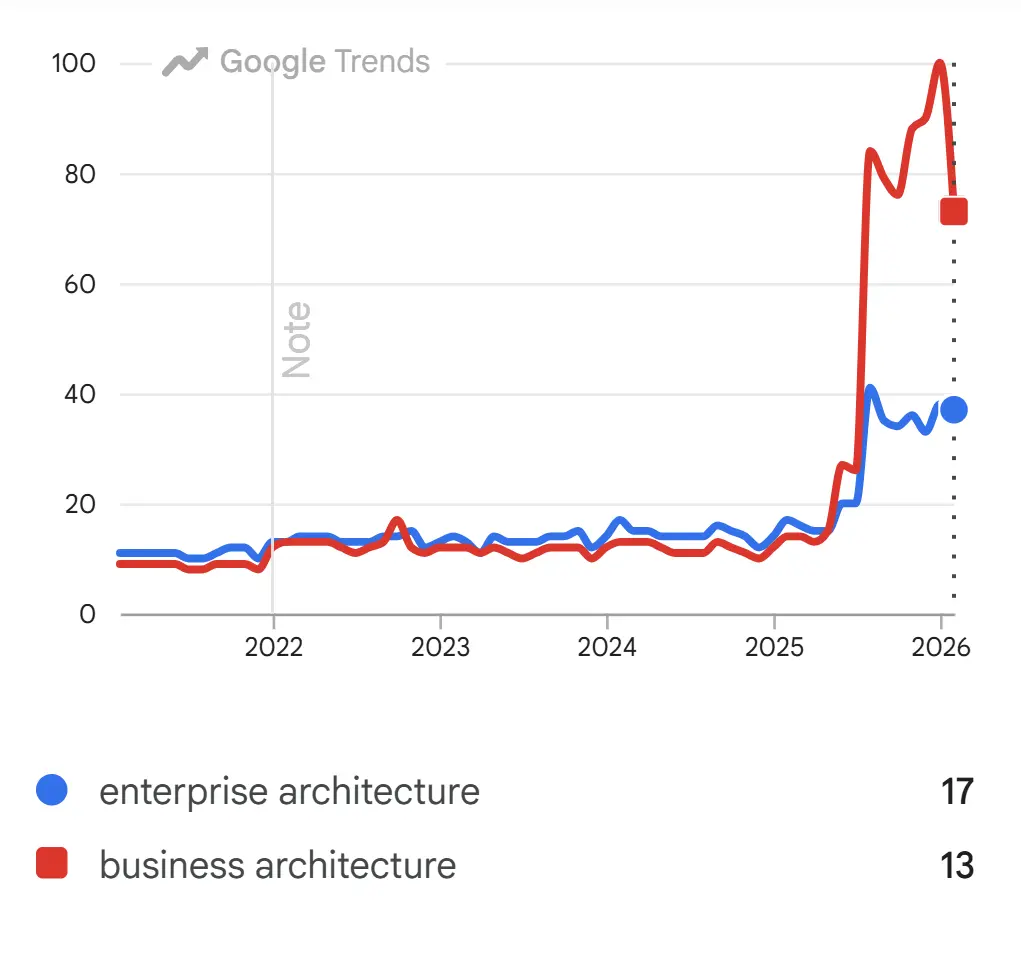
Tools like LeanIX and Ardoq are seeing 300% breakouts in interest specifically because they have realized that to sell to the modern enterprise, they must cater to the Business Architect, not just the IT manager. The C-suite is actively searching for ways to bypass the IT bottleneck and directly map their strategic initiatives to operational realities. The migration of capital and attention from IT-centric EA to Strategy-centric BA is undeniable.
The Architecture Hierarchy
Defines capabilities, value streams, and strategy. Dictates all downstream investments. It is the core driver of the organization.
Structures the information required to execute the business capabilities. Ensures data is treated as an enterprise asset.
Selects the software and tools needed to manage the data and support the business processes efficiently.
The foundation. Provides the hardware, cloud infrastructure, and networks to run the applications reliably.
How to Pivot: Implementing a Business-Centric Blueprint
For the enlightened executive, the path forward is clear. You must elevate your architectural practice out of the server room and into the boardroom. Here is how the transition is executed by top-tier enterprises:
1. Reassign Ownership If your Enterprise Architecture group reports to the CIO, you have a structural bottleneck. Business Architecture must report directly to the COO, the Chief Strategy Officer, or the CEO. It must sit at the nexus of strategy and operations, completely independent of technology biases.
2. Map Capabilities, Not Systems Stop auditing your applications. Start mapping your capabilities. Create a comprehensive Business Capability Map. When you understand what your business must do to survive and thrive, you can immediately identify which legacy IT systems are redundant and which capabilities are severely underfunded.
3. Demand Value Stream Justification Never approve another IT infrastructure project unless it is explicitly tied to a Business Value Stream. If the Enterprise Architects cannot draw a direct line from a server upgrade to an optimized customer capability, the project is denied. Period.
4. Change the Language Eradicate IT jargon from strategic planning sessions. If an architect cannot explain a proposed change using the vocabulary of capabilities, customer value, and strategic alignment, send them back to the drawing board. Business alignment requires business language.
Conclusion: The Final Verdict
Traditional Enterprise Architecture is evolving because it has no choice. In an era where agility is the only sustainable competitive advantage, organizations can no longer afford the luxury of bloated, IT-centric architectural frameworks that fail to move the needle.
Business Architecture is not a passing trend; it is the maturation of the enterprise design discipline. It is the realization that technology is merely an enabler, a commodity to be utilized only when the business strategy demands it.
The companies that will dominate the next decade are those that recognize this shift today. They will stop letting technologists dictate their business strategy, and they will start using Business Architecture to design a lean, lethal, and perfectly aligned enterprise. The question is not whether Enterprise Architecture is yielding to Business Architecture. The only question is how quickly your organization is willing to adapt to the new hierarchy.