
Coso vs Cobit: Governance and Risk Management
Explore the essential differences, similarities, and integration of the COSO and COBIT frameworks for modern risk management.

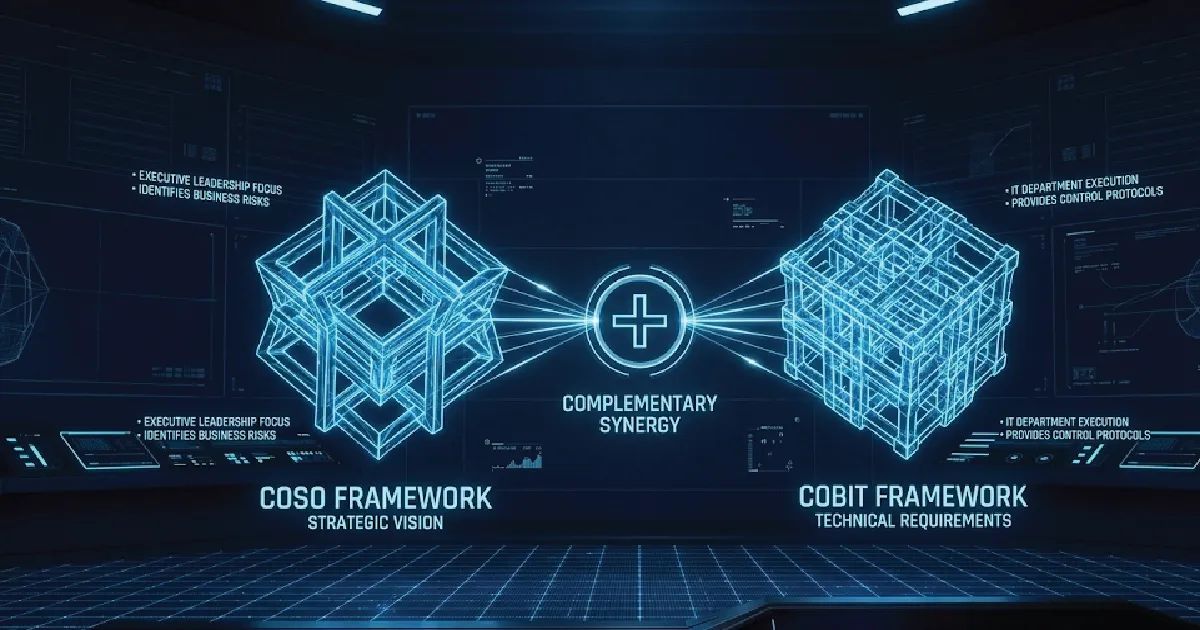
As digital transformation accelerates and regulatory scrutiny intensifies, leaders are increasingly turning to established frameworks to provide structure to their internal control environments. Two names consistently dominate this conversation: COSO and COBIT.
While often discussed in the same breath, these frameworks serve distinct roles within an enterprise. This guide provides an in-depth analysis of coso vs cobit, exploring how they differ, where they overlap, and why their integration is often the "gold standard" for organizations aiming for excellence in both financial reporting and IT governance.
What do the acronyms COSO and COBIT stand for?
To understand the debate of coso vs cobit, one must first understand their origins.
COSO stands for the Committee of Sponsoring Organizations of the Treadway Commission. Founded in 1985, it is a joint initiative of five private-sector organizations: the AICPA, the AAA, the IIA, the IMA, and the FEI. According to the official COSO mission, it was established to study the factors that can lead to fraudulent financial reporting. The commission was named after its first chairman, James C. Treadway, Jr., and its work became the foundational standard for internal control systems worldwide following the publication of its first report in 1987.
COBIT stands for Control Objectives for Information and Related Technologies. Introduced by ISACA (Information Systems and Audit and Control Association) in 1996, it was designed specifically to help organizations manage and govern their IT environments. Over the decades, it has evolved from a simple set of control objectives into a comprehensive enterprise IT governance framework. The most recent iteration, COBIT 2019, was developed to address the rapid changes in technology, including cloud computing and Agile methodologies.
What is the primary difference between Coso vs Cobit?
The most fundamental distinction between coso vs cobit lies in their scope and focus.
COSO is a broad, high-level, and principles-based framework. It is designed to provide a "tone at the top" for the entire enterprise. It focuses on the conceptual structure of internal controls to ensure reliable financial reporting, efficient operations, and compliance with laws. It is the language of the Board of Directors and the CFO, focusing on fiduciary duty and corporate responsibility.
In contrast, COBIT is a more technical, detailed, and IT-centric framework. While it aligns with business goals, its primary "battleground" is the information technology landscape. It provides the "how-to" for designing secure IT systems, managing digital assets, and ensuring that technology investments deliver the value promised to stakeholders. Unlike COSO, which defines what is needed, COBIT offers a maturity model—often aligned with CMMI standards—to measure how well those processes are performing.
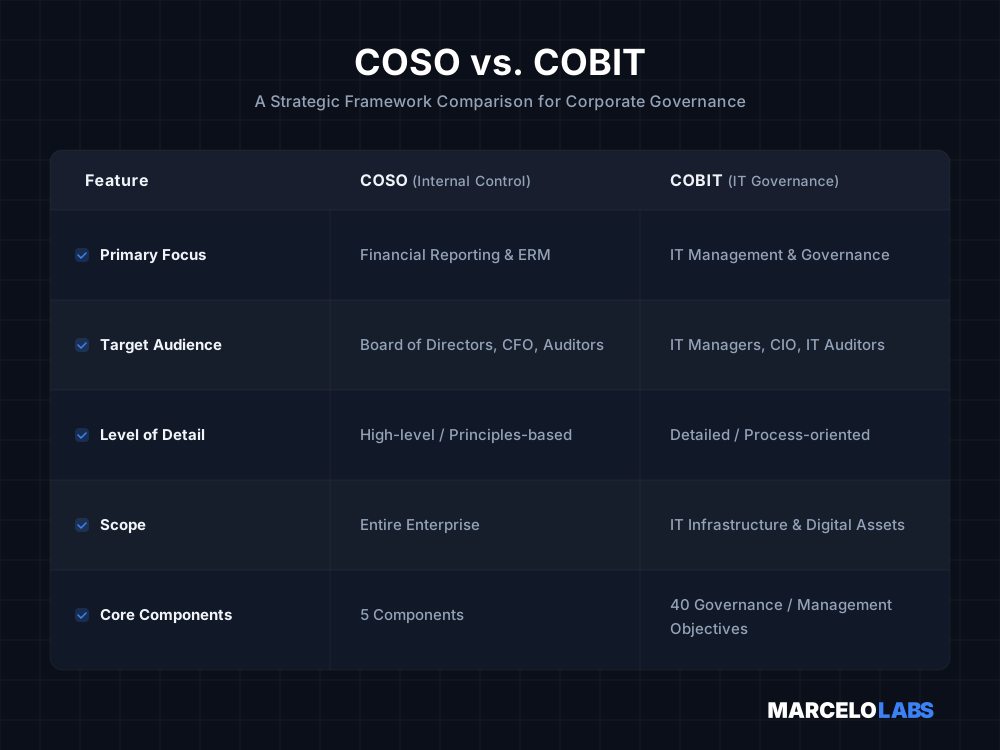
In short: COSO tells you what controls you need to have at an organizational level; COBIT tells you how to implement those controls within your IT infrastructure.
Why are the COSO and COBIT frameworks so important for SOX compliance?
Since the passage of the Sarbanes-Oxley Act (SOX) in 2002—triggered by massive corporate frauds at companies like Enron and Tyco—the stakes for internal controls have never been higher. Section 404 of SOX requires management to certify the effectiveness of their Internal Control over Financial Reporting (ICFR).
However, the legislation itself does not provide a roadmap for how to achieve this. This is where the synergy between coso vs cobit becomes vital.
- The COSO Foundation: Most public companies in the U.S. use the COSO Internal Control—Integrated Framework as their primary basis for SOX compliance. It provides the five essential components—Control Environment, Risk Assessment, Control Activities, Information and Communication, and Monitoring—that auditors look for to verify the "tone at the top."
- The COBIT Implementation: Because financial reporting today is almost entirely digital, an organization cannot claim to have "effective internal controls" if its IT systems are vulnerable. COBIT provides the granular detail needed to secure the IT general controls (ITGCs) that support the financial data governed by COSO. Many auditors use COBIT to bridge the gap between high-level business risks and specific technical vulnerabilities.
Understanding the synergy: COSO and COBIT as complementary forces
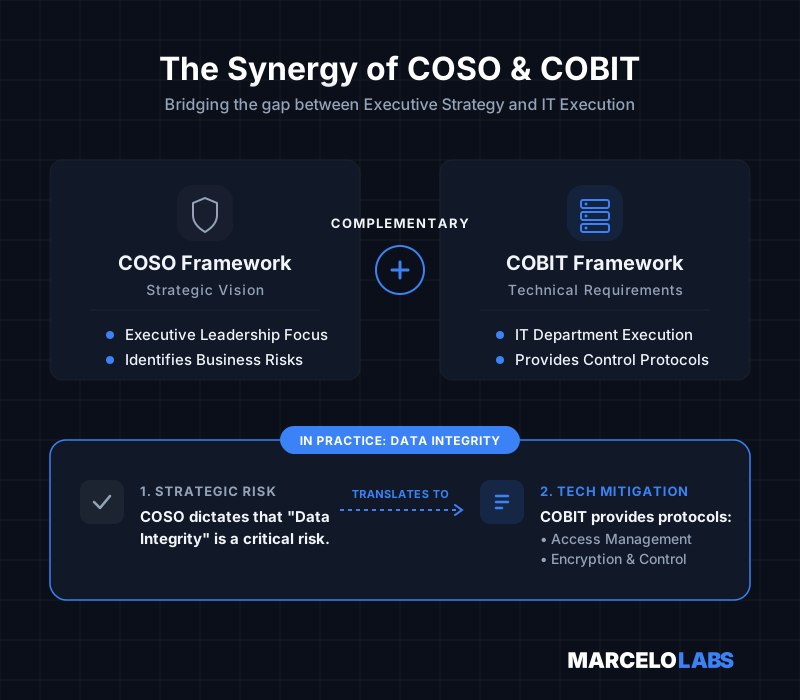
A common misconception is that an organization must choose one over the other. In reality, leading enterprises leverage both coso and cobit to create a holistic governance environment.
By using coso and cobit in tandem, an organization can bridge the gap between executive leadership and the IT department. COSO provides the strategic vision, while COBIT translates that vision into technical requirements. For example, if COSO identifies "Data Integrity" as a high-level risk, COBIT provides the specific protocols for access management, change control, and encryption to mitigate that risk.
The Five Components of COSO
To appreciate the breadth of COSO, one must examine its five interrelated components:
- Control Environment: The set of standards, processes, and structures that provide the basis for carrying out internal control across the organization. This includes ethical values and the organizational structure.
- Risk Assessment: A dynamic and iterative process for identifying and analyzing risks to achieving objectives, considering both internal and external factors.
- Control Activities: The actions established by policies and procedures (preventive or detective) to help ensure that management directives to mitigate risks are carried out.
- Information and Communication: The process of providing, sharing, and obtaining necessary information of sufficient quality to support the internal control system across all levels.
- Monitoring Activities: Ongoing evaluations (often performed by Internal Audit) to ascertain whether each of the five components of internal control is present and functioning.
The Six Principles of COBIT 2019
COBIT 2019 refined its predecessor by introducing six core principles for a governance system. As detailed in the ISACA COBIT 2019 Framework Introduction, these include:
- Provide Stakeholder Value: Balancing benefits, risk, and resources to satisfy the needs of those with a vested interest in the enterprise.
- Holistic Approach: Looking at the enterprise end-to-end, including culture, ethics, and people, not just software.
- Dynamic Governance System: Allowing the system to react to changes in the business or regulatory environment.
- Governance Distinct from Management: Differentiating the "Evaluate, Direct, Monitor" functions of the board from the "Plan, Build, Run, Monitor" functions of management.
- Tailored to Enterprise Needs: Using specific "design factors" (like risk profile or industry) to customize the governance system.
- End-to-End Governance System: Covering all functions and processes where information is processed, regardless of where they reside in the organization.
Comparing Coso vs Cobit vs NIST: When do you use which?
As organizations mature, they often encounter other frameworks, such as the NIST Cybersecurity Framework (CSF). When evaluating coso vs cobit vs nist, it helps to view them as layers of a pyramid.
- COSO (The Top): The overarching governance and financial reporting framework used for corporate-wide compliance and ERM.
- COBIT (The Middle): The bridge that connects business objectives to IT management, covering the full lifecycle of IT services.
- NIST (The Base): A specialized, outcome-based framework specifically for managing and reducing cybersecurity risk through its Core Functions: Identify, Protect, Detect, Respond, and Recover.
While COBIT is broad across all of IT (including procurement and project management), NIST is laser-focused on the technical defense against cyber threats. Many organizations map NIST controls into their COBIT processes, which in turn report up into their COSO-based internal control assessments.
How do COSO and COBIT handle Risk Management?
The approach to risk is a significant point of comparison in the coso vs cobit analysis.
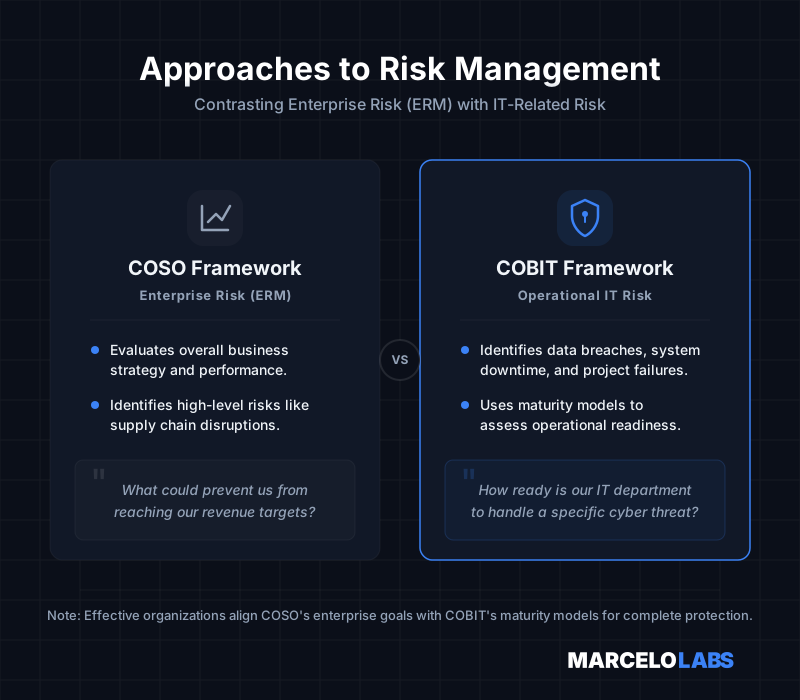
COSO views risk through the lens of Enterprise Risk Management (ERM). It looks at how risk affects the overall strategy and performance of the business. It asks: "What could prevent us from reaching our annual revenue targets?" or "What risks exist in our supply chain?"
COBIT, meanwhile, focuses on IT-related risk. It provides a structured way to identify risks such as data breaches, system downtime, or IT project failures. COBIT’s risk management is more operational; it uses maturity models to assess how "ready" an IT department is to handle a specific threat.
Mapping Coso vs Cobit: A Practical Approach for Auditors
For internal auditors, mapping these frameworks is a critical task. Relying on spreadsheets is often insufficient in the modern era. Using automated GRC (Governance, Risk, and Compliance) software allows teams to visualize how a single technical control in COBIT (like a password policy or multi-factor authentication) satisfies multiple requirements in COSO (like "Control Activities" and "Information Security").
This "map once, comply many" approach saves hundreds of hours during the annual audit cycle and ensures that there are no "blind spots" where IT risks could undermine financial statements.
Conclusion: Which framework is right for your organization?
In the final assessment of coso vs cobit, the answer is rarely "either/or."
If your organization is a public company or one that requires high levels of fiduciary transparency, COSO is your non-negotiable foundation. It is the language of your auditors and your board.
However, if your organization relies on complex IT systems to deliver value—which describes virtually every modern business—COBIT is the necessary engine to make those COSO principles actionable.
The most successful organizations do not view these as competing standards but as synergistic tools. By integrating coso and cobit, you move beyond mere compliance and toward a state of operational excellence, where risks are not just managed, but understood, and technology is not just a cost center, but a strategic driver of growth.
Whether you are preparing for a SOX audit or looking to modernize your IT governance, understanding the nuances of coso vs cobit is the first step toward a more secure and efficient future.