A Strategic Guide to Enterprise Key Management
Stop losing control of your data in the cloud. Discover how Enterprise Key Management (EKM) acts as the cryptographic nervous system for modern security architecture and governance.


As organizations undergo the complex process of Reengineering their technological foundations, the shift toward decentralized data and multi-cloud environments has introduced a significant challenge: the management of the very "keys" to the kingdom. Enterprise Key Management (EKM) has evolved from a niche technical requirement into a cornerstone of modern Security Architecture and Governance.
For the modern enterprise, encryption is ubiquitous. However, encryption without a centralized, rigorous management strategy is merely a temporary delay for an adversary. To achieve true operational resilience, business leaders must view key management not as a background process, but as a strategic asset that ensures data sovereignty, regulatory compliance, and architectural integrity.
What is Enterprise Key Management and Why is it the Foundation of Modern Security?
At its core, Enterprise Key Management refers to the centralized practices, policies, and technologies used to secure and manage the entire lifecycle of cryptographic keys across an organization’s infrastructure. Unlike traditional, siloed key management—where each application or cloud provider handles its own encryption—an enterprise-grade solution provides a "single pane of glass" for visibility and control.
From an Architectural perspective, EKM acts as the nervous system of data protection. It ensures that whether data resides in a local database, a SaaS application like Slack or OpenAI, or a public cloud provider like AWS or Azure, the organization remains the sole arbiter of who can access that information. By centralizing these functions, companies eliminate "key sprawl," reduce the risk of human error, and ensure that security policies are applied consistently across the entire business ecosystem.
How Does Enterprise Key Management Support Governance and Regulatory Compliance?
In the realm of Governance, the ability to prove control is as important as the control itself. Global regulations such as GDPR, HIPAA, and PCI-DSS mandate stringent protections for sensitive data. An effective Enterprise Key Management strategy provides the granular audit trails and reporting capabilities necessary to satisfy these requirements.
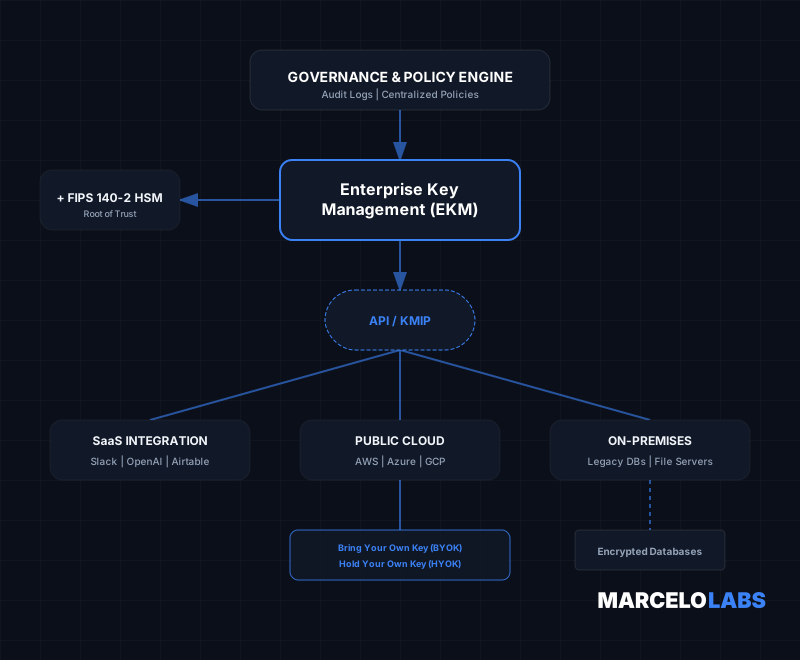
Key management solutions often utilize Hardware Security Modules (HSMs)—tamper-resistant hardware that performs cryptographic operations and stores keys in a FIPS 140-2 Level 3 validated environment. By integrating these into the governance framework, organizations can:
- Enforce Separation of Duties: Ensuring that the individuals who manage the data (DBAs or Cloud Admins) are not the same individuals who manage the encryption keys.
- Automate Compliance Reporting: Generating immutable logs that show exactly when a key was used, rotated, or retired.
- Ensure Data Portability: Maintaining control over keys even when using third-party services, allowing for a "Kill Switch" capability if a service provider is compromised.
The Architecture of Trust: A Visual Representation
To understand how EKM integrates into a complex environment, we must look at the flow between the management layer and the consumption layer.
What are the Core Components of a Key Lifecycle Management Strategy?
Effective Security Operations rely on a predictable and automated key lifecycle. A robust Enterprise Key Management solution automates the following stages to prevent operational downtime and security gaps:
- Generation: Creating keys using high-entropy random number generators, ensuring they are cryptographically strong.
- Storage: Protecting keys within secure boundaries (HSMs or software-defined vaults) so they are never exposed in plaintext.
- Distribution: Safely delivering keys to authorized applications through secure protocols like KMIP (Key Management Interoperability Protocol).
- Rotation: Periodically changing keys to limit the amount of data encrypted with a single key, thereby reducing the "blast radius" of a potential compromise.
- Revocation and Destruction: Ensuring that when a key is no longer needed, or if a breach is suspected, it can be immediately invalidated and rendered unrecoverable.
How Can Organizations Implement Enterprise Key Management in a Multi-Cloud World?
As businesses reengineer their operations toward the cloud, they often face a dilemma: use the cloud provider's native tools or implement a third-party EKM. While AWS KMS or Azure Key Vault are excellent for internal cloud services, they create silos in a multi-cloud strategy.
The professional recommendation for large-scale Architecture is the adoption of Bring Your Own Key (BYOK) or Hold Your Own Key (HYOK) models. These approaches allow the enterprise to generate keys within their own HSMs and "lease" them to the cloud provider. This ensures that even if a cloud provider receives a government subpoena for data, the organization remains in control of the encryption keys, effectively maintaining a veto power over data access.
What Are the Strategic Benefits of Integrating EKM into Security Operations?
Integrating Enterprise Key Management into your Security Operations provides more than just protection; it provides agility.
- Operational Efficiency: Instead of managing 50 different encryption methods across 50 different apps, teams manage one centralized system.
- Risk Mitigation: Centralization allows for instant response. If a specific region is compromised, keys for that region can be rotated or revoked globally within minutes.
- Future-Proofing: As we approach the era of quantum computing, having a centralized EKM allows organizations to upgrade their cryptographic algorithms (Post-Quantum Cryptography) in one place rather than updating every individual application.
Conclusion: Reengineering Security for an Uncertain Future
The transition to a more resilient business model requires a fundamental rethink of how we protect our most valuable asset: data. Enterprise Key Management is not merely a box to be checked for an audit; it is the architectural framework that enables secure innovation.
By prioritizing a centralized, HSM-backed EKM strategy, organizations can bridge the gap between complex Operations and rigorous Governance. In an age where data breaches are increasingly common, the question is no longer whether you are encrypting your data, but who truly holds the keys. For the forward-thinking enterprise, the answer must always be: "We do."