The Symbiotic Future of Enterprise Architecture and AI
Explore how Enterprise Architecture and AI converge to eliminate architectural debt, automate governance, and orchestrate intelligent, real-time business operations.


The convergence of enterprise architecture and AI is no longer a speculative trend but a fundamental operational necessity. As organizations transition from experimentation to industrial-scale implementation, the role of the Enterprise Architect (EA) has evolved from a traditional custodian of IT blueprints to a strategic orchestrator of intelligent ecosystems.
This transformation represents a paradigm shift where AI acts as both a catalyst for architectural agility and a complex workload that requires rigorous structural discipline. To succeed, modern leaders must understand how these two domains reinforce one another: AI provides the speed and insights required for modern business, while Enterprise Architecture provides the governance, security, and data strategy necessary for sustainable adoption.
How Does Enterprise Architecture and AI Redefine Modern Business Strategy?
Enterprise Architecture (EA) has traditionally been the bridge between business goals and technical execution. In the age of artificial intelligence, this bridge must now support the weight of massive data flows and real-time decision-making.
Integrating enterprise architecture and AI allows organizations to move away from siloed "shadow AI" projects toward a unified corporate strategy. Without a robust architectural foundation, AI initiatives often become expensive experiments that fail to scale. A well-defined Business Process Architecture Framework is essential here; it provides the necessary baseline for identifying where AI can truly add value, ensuring that automated processes are not just faster, but strategically aligned with the organization's core mission.
By mapping the data landscape EA ensures that AI models have access to high-quality, relevant data. This alignment accelerates Return on Investment (ROI) and prevents the "garbage in, garbage out" cycle that plagues many early-stage AI implementations.
Why is AI a Game-Changer for Architectural Modeling and Insights?
For decades, Enterprise Architecture was criticized for being too static—a collection of "ivory tower" diagrams that were obsolete by the time they were published. AI is fundamentally changing this perception by transforming EA from a documentation exercise into a real-time intelligence capability.
Generative AI and machine learning tools can now automate the documentation of existing systems, identifying inconsistencies or gaps in the architecture that a human might miss. This shift toward "Real-Time EA" enables:
- Automated Pattern Recognition: AI can scan vast codebases and infrastructure logs to generate current-state diagrams automatically.
- Predictive Impact Analysis: Architects can use AI to simulate changes—creating "digital twins" of the organization—to predict how a new technology might affect upstream and downstream dependencies.
- Knowledge Synthesis: Large Language Models (LLMs) can ingest thousands of pages of technical documentation to provide architects with immediate answers regarding compliance, technical standards, and historical design decisions.
What are the Security and Governance Pillars for AI-Enabled Architecture?
As AI becomes a "first-class workload" in the enterprise, security and governance become the most significant hurdles. The "black box" nature of some AI models creates risks related to data privacy, ethical bias, and intellectual property.
An AI-ready architecture must implement a multi-layered governance strategy:
- The Data Layer: Ensuring that the data used for training and inference is governed by strict privacy controls and lineage tracking.
- The Model Layer: Establishing standards for model performance, transparency, and "explainability" to meet regulatory requirements.
- The Guardrail Layer: Implementing real-time monitoring to detect anomalies, prevent data leakage, and ensure that AI outputs remain within the bounds of corporate policy.
Architecture provides the "guardrails" that allow developers to innovate without compromising the security posture of the firm. By embedding these controls into the architectural fabric, governance moves from a reactive checkpoint to a proactive, automated feature of the system.
How Can AI Mitigate Architectural Debt and Legacy Constraints?
One of the most persistent challenges for any Enterprise Architect is the management of legacy systems. These aging infrastructures often harbor significant Architectural Debt, which acts as a drag on innovation and a source of operational risk.
The synergy between enterprise architecture and AI offers a unique solution for legacy system migration. AI-powered tools can analyze legacy code to identify refactoring opportunities, translate outdated languages into modern frameworks, and map complex dependencies that would take human teams months to untangle.
By using AI to systematically address architectural debt, organizations can modernize their operations while maintaining continuity. This reengineering process is not just about replacing old hardware; it’s about reimagining the business logic through the lens of modern, modular, and AI-enabled design patterns.
What are the Essential Steps for an AI-Ready Enterprise Architecture Roadmap?
To successfully merge enterprise architecture and AI, leaders must follow a structured path that balances technical capability with organizational readiness. A robust roadmap typically includes:
- Baseline Assessment: Use AI to audit current systems and identify "Architectural Debt" that might hinder AI integration.
- Strategy Alignment: Map AI use cases to the "Business Process Architecture Framework" to ensure every model serves a high-value business objective.
- Infrastructure Readiness: Modernize data pipelines to support real-time inference and ensure your cloud or hybrid infrastructure can handle high-compute AI workloads.
- Iterative Governance: Start with small, controlled "sandboxes" for AI experimentation, then scale the governance guardrails as the models move toward production.
What Does AI-Driven Operations Mean for the Future of Reengineering?
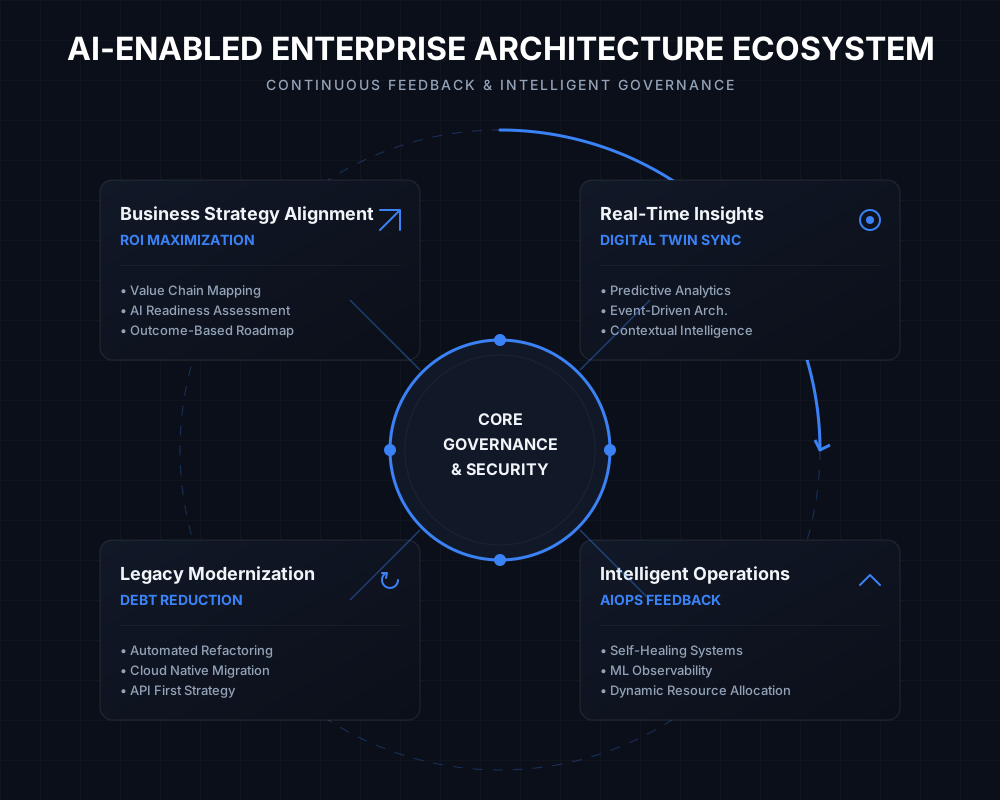
Beyond the design phase, AI is revolutionizing the operational layer of enterprise architecture. "AIOps" uses machine learning to monitor system performance, predict bottlenecks, and even initiate self-healing protocols.
In an AI-augmented operational environment:
- Infrastructure becomes self-configuring: Systems can adapt to workload changes in real-time based on predictive demand.
- Root cause analysis is instantaneous: AI can correlate millions of events across the stack to identify the precise origin of a failure.
- Continuous Reengineering: The feedback loop between operations and architecture becomes a closed circle. Data from live operations informs the next iteration of architectural design, creating a truly evolutionary enterprise.
Conclusion: Embracing the EA and AI Convergence
The integration of enterprise architecture and AI represents the next frontier of corporate maturity. It is no longer enough to "do AI"; organizations must "be AI" at their very core. This requires a transition from being mere documenters of the past to being strategic advisors who shape the future.
By prioritizing security, governance, and the aggressive reduction of architectural debt, the modern Enterprise Architect ensures that the organization is not just adopting a new tool, but building a resilient, intelligent, and perpetually evolving digital organism. The journey toward a truly intelligent enterprise is complex, but with the right architectural framework, it is a journey that promises unprecedented competitive advantage.