Mastering Business Process Architecture: The Definitive Blueprint for Elite Operational Orchestration
Discover how Business Process Architecture (BPA) acts as the master blueprint to eliminate operational rot and translate executive intent into data-driven reality.


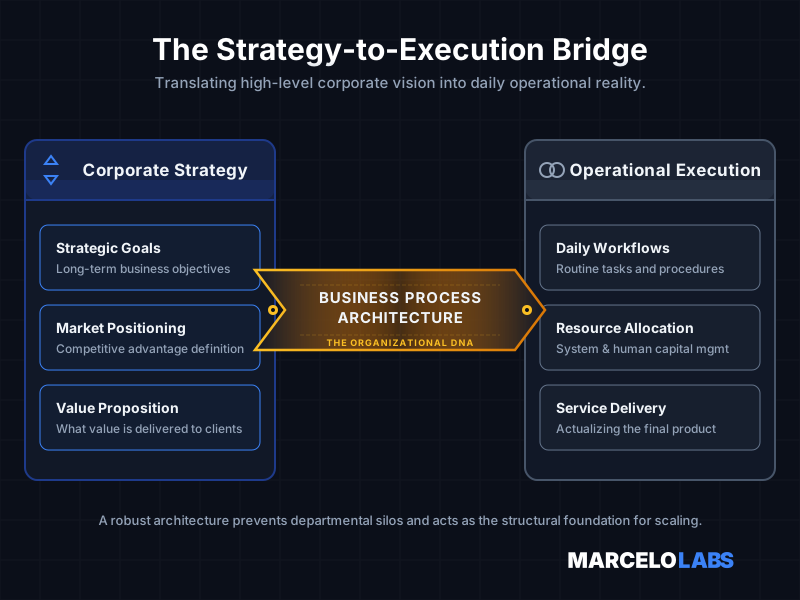
The most successful organizations distinguish themselves not just through what they do, but through the clarity of how they do it. This clarity is found within the business process architecture—a strategic, hierarchical model that serves as the "DNA" of an enterprise.
A robust business process architecture is far more than a collection of flowcharts; it is a sophisticated management tool that aligns daily operations with high-level strategy. It provides a visual and structural foundation that allows leaders to see through the fog of departmental silos and understand how value is truly created, accumulated, and delivered to the end customer.
What is Business Process Architecture and Why is it the Secret to Scaling?
At its core, business process architecture is a hierarchical representation of an organization's business processes. While many managers confuse simple process mapping with architecture, the difference lies in the interconnectedness and hierarchy. Mapping shows you a path; architecture shows you the entire city and how its infrastructure supports its inhabitants.
Without a formalized architecture, organizations often suffer from "accidental complexity"—a state where processes evolve in isolation, leading to redundant efforts, inconsistent data, and a fundamental disconnect between executive vision and operational reality. By documenting the architecture, you create a "single source of truth" that facilitates:
- Strategic Alignment: Ensuring every activity contributes to the value chain.
- Operational Transparency: Identifying exactly where bottlenecks and hand-offs occur.
- Agility: Enabling the organization to pivot by understanding which processes are affected by a change in strategy.
How to Create a Business Process Architecture Model that Aligns Strategy with Execution?
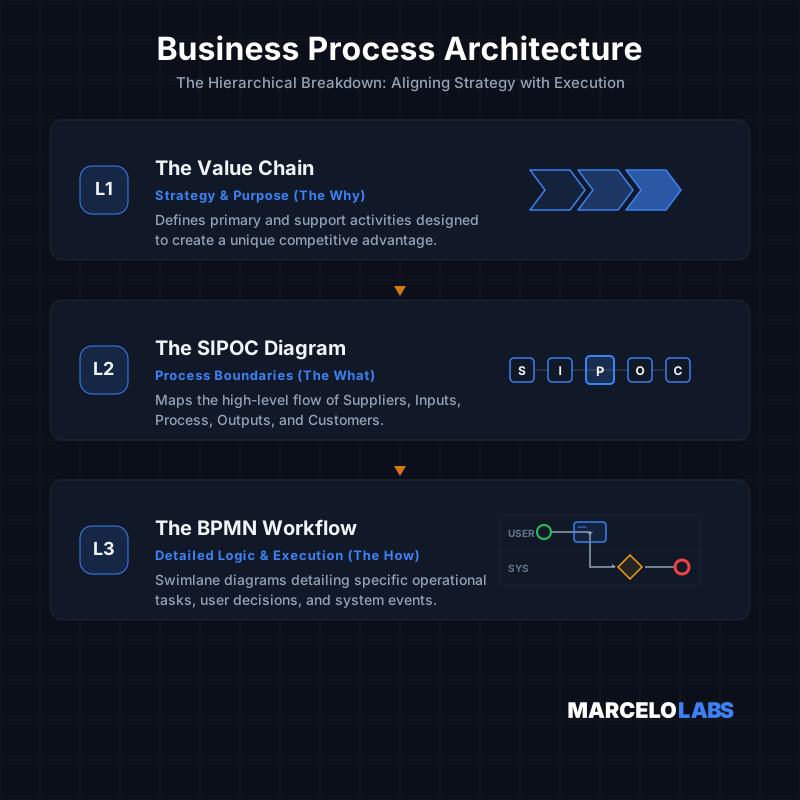
Building an architecture is an exercise in "top-down" thinking. It begins with the Why (Strategy) and cascades down to the How (Tasks). To create a model that yields a high return on investment, one must look at the organization through three distinct lenses:
1. The Value Chain (Level 1)
Inspired by Michael Porter, this level defines the purpose of the company. It identifies the primary activities (Inbound Logistics, Operations, Marketing) and support activities (HR, IT, Procurement) that create a competitive advantage.
2. The SIPOC Diagram (Level 2)
At this stage, we define the What. A SIPOC (Suppliers, Inputs, Process, Outputs, Customers) diagram identifies the boundaries of each process. It ensures that the architecture isn't just a list of names, but a defined flow of information and materials.
3. The BPMN Workflow (Level 3)
This is the How. Using Business Process Model and Notation (BPMN), architects create detailed "swim lane" diagrams. This level is where the actual logic of the business resides—decisions, events, and specific activities.
The Hierarchical Blueprint: Understanding L1, L2, and L3 Process Levels
In the realm of business process architecture framework design, the concept of levels is paramount. You will often hear architects discuss L1 through L5. Understanding these layers prevents the common mistake of "getting lost in the weeds" too early.
- Level 1 (Process Categories): These are the highest-level groupings, often categorized into Core, Support, and Management processes.
- Level 2 (Process Groups): These group related processes together, such as "Order-to-Cash" or "Hire-to-Retire."
- Level 3 (Business Processes): The end-to-end flow of a specific business objective.
- Level 4 & 5 (Sub-processes and Tasks): These represent the granular steps and work instructions carried out by individuals.
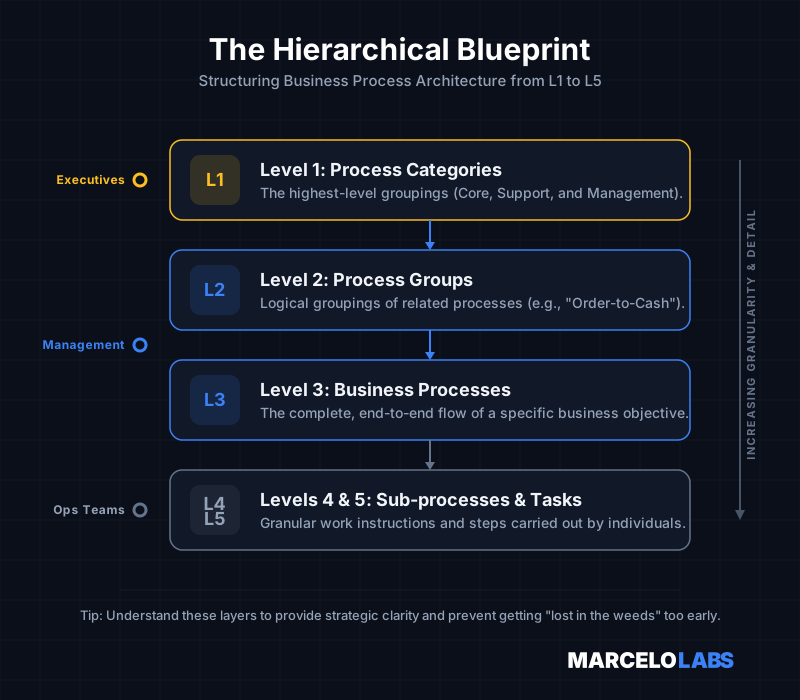
By maintaining this hierarchy, an organization can provide senior executives with a high-level L1 view for strategic planning, while providing operational teams with the L3-L5 detail they need for execution.
How Does Process Architecture Align with Enterprise Frameworks?
Process architecture does not exist in a vacuum. It is a critical component of the broader Enterprise Architecture (EA). While process architecture focuses on the flow of work, other frameworks focus on the structure of the entire enterprise.
For instance, when designing a process, one must consider the underlying data and technology. This is where the intersection of different frameworks becomes vital. To understand the broader context of how these systems interact, it is helpful to compare established methodologies like the Zachman Framework vs. TOGAF. While TOGAF provides a process-heavy approach to building architecture, Zachman offers a structured "schema" for looking at the enterprise from different perspectives (Who, What, Where, When, Why, How).
Integrating your process architecture with these enterprise-level frameworks ensures that your "How" is supported by the right "What" (Technology) and "Who" (People).
SIPOC and BPMN: Which Frameworks Define Modern Process Architecture?
The choice of framework often dictates the success of the architecture. Leading process professionals rely on standardized languages to ensure that the architecture is readable by both humans and machines.
- BPMN 2.0: The global standard for process modeling. It provides a graphical notation that is intuitive for business users yet sufficiently technical for IT to implement via automation.
- APQC Process Classification Framework (PCF): Many organizations use the APQC PCF as a starting point. It provides a pre-defined "taxonomy" of processes for different industries, preventing the need to reinvent the wheel.
- Value Stream Mapping (VSM): Often used in Lean environments to identify waste and improve the flow of value through the process architecture.
Beyond Mapping: The Seven Essentials of an Effective Process Architecture
To move from a static document to a living management tool, your business process architecture must incorporate the "Seven Essentials" of process excellence:
- Connection to Strategic Goals: If a process doesn't serve a KPI or a strategic imperative, it should be questioned.
- Explicit Process Ownership: Every process needs a "Process Owner"—an individual with the authority to change and optimize the process across functional boundaries.
- Governance Mechanism: Processes change. A governance board ensures that a change in one process doesn't inadvertently break another.
- Resource Alignment: The architecture should clearly show which roles and systems are required for each step.
- Performance Metrics: You cannot manage what you do not measure. Cycle time, error rates, and cost-per-transaction should be linked to the architecture.
- Communication Plan: The architecture must be accessible. Many successful firms turn their architecture into a "Process Portal" or intranet.
- Continuous Improvement Loop: Architecture is not a project; it is a practice. It must evolve as the market and technology (such as AI) change the way work is done.
Measuring Success: How to Use BPA to Prioritize Performance and Improvement?
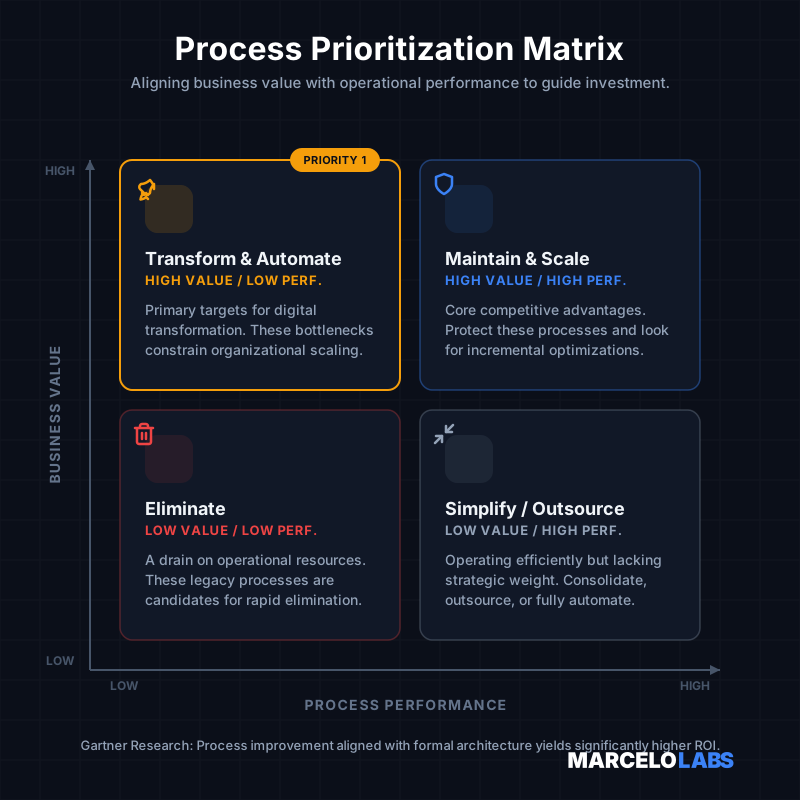
One of the most significant benefits of a well-defined business process architecture mapping is the ability to prioritize investments. Every organization has a limited budget for improvement. By looking at the architecture, leaders can identify which processes are:
- High Value / Low Performance: These are the primary targets for digital transformation and automation.
- Low Value / High Complexity: These are candidates for elimination or simplification.
Organizations that align their process improvement projects with a formal architecture realize significantly higher ROI than those that approach improvement in a fragmented, departmental manner. This is because architecture reveals the interdependencies—improving one step doesn't help if it simply moves the bottleneck further down the line.
Conclusion: The Architecture of the Future
In an era of rapid digital disruption, business process architecture is the anchor that keeps an organization grounded while allowing it to move with speed. It transforms the "black box" of operations into a transparent, measurable, and improvable asset.
By investing in a professional architecture—defined by clear hierarchies, standardized notations like BPMN, and a strong link to strategic frameworks—your organization can move beyond surviving complexity to mastering it. As you refine your processes, remember that the goal is not just to document what you do, but to design a future where your organization operates with unparalleled elegance and efficiency.
For those looking to deepen their understanding of how these architectural decisions impact the broader organizational structure, exploring the nuances of enterprise architecture management is a recommended next step in your professional journey.